There's a particular sound that tells you something is wrong with a historic wall. Tap it with your knuckle, and instead of the dull thud you expect from brick, you get a hollow crack. Then look down. There's a small pile of brick dust on the pavement, and the face of the brick above the joint has started to come away in flakes.
The culprit is almost always the mortar. Not the ancient lime mortar the wall was built with — the hard, grey, cement-rich mortar someone repointed it with two or three decades ago. That repair is now destroying the masonry it was meant to protect. And it's one of the most common problems I run into whenever I'm asked to look at a period building.
Here's what's really going on, why cement mortar damages historic brick and stone, and how to tell whether your wall is already suffering from it.
Key Takeaways
- Historic masonry was built to work with soft, porous lime mortar. Cement is harder, denser and far less vapour-permeable — and that mismatch is the whole problem.
- The damage shows up in the brick or stone, not in the mortar. That's counterintuitive, and it's why so many people misdiagnose it.
- You can test for cement mortar yourself: a small sample fizzes weakly or not at all in dilute acid, and it's hard to scratch with a nail.
- Repointing in lime is the fix. Repointing in cement is what caused the problem in the first place.
Why cement mortar damages historic brick and stone
The single sentence version: old masonry needs to breathe, and cement doesn't let it.
Brick and stone are porous. Water vapour moves through them constantly — in from the outside during wet weather, out toward the surface when things dry. The mortar joint is part of that system. Lime mortar is deliberately soft, permeable and slightly weaker than the units around it. When movement happens (and in an old wall, movement always happens), the mortar is what gives. It takes the strain, cracks a little, and the brick and stone stay intact.
That's the whole design principle. The mortar is a sacrificial layer.
The mechanics, in plain terms
Swap lime for cement and you invert the hierarchy. Cement mortar is significantly harder and stiffer than a historic brick. It's also far less vapour-permeable. Now the soft element is the masonry, and the hard element is the joint. So when the wall expands and contracts, or when moisture needs to escape, the stress lands where it does the most damage — in the brick.
The visible result is the pattern every conservation officer recognises on sight: intact cement joints sitting between bricks whose faces have spalled away. The joint survived because it won. The brick lost.
- Water gets trapped behind a cement skin and has nowhere to evaporate
- Soluble salts crystallise just below the surface, and the pressure blows the brick face off
- Thermal movement in a rigid joint cracks the softer unit instead
The same logic applies to stone, though the failure looks different. On limestone and sandstone, a hard cement pointing traps moisture and salts that then attack the stone from behind the joint — leaving deep pitting, powdering surfaces and dark staining that follows the joint lines.
Can I use mortar repair on historic brick?
Not in the sense most people mean. A bag of general-purpose mortar repair from a builders' merchant is cement-based, and using it on pre-1919 brick is precisely the mistake that causes the damage described above. If the repair is small and cosmetic and the building is modern, fine. On a listed or period wall, no.
What you need instead is a repair mix that matches the original in softness, permeability and colour — which for almost all pre-20th-century masonry means a lime-based mortar, not cement. It's slower to set, it needs protecting from frost and fast drying, and it doesn't behave like anything you've used before if your background is modern construction. That's the honest trade-off.
Why is the mortar between my bricks crumbling?
Crumbling joints have a few possible causes, and it matters which one you have, because the remedy differs.
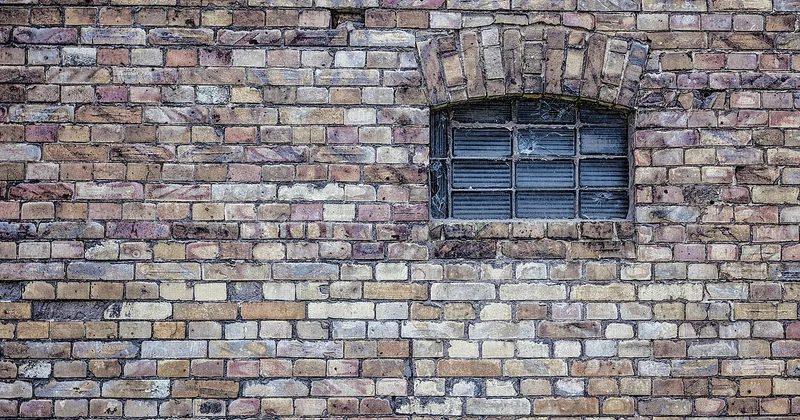
The most likely explanation on an old wall is simply age. Lime mortar has a finite life — a few decades to well over a century depending on exposure — and it fails by powdering and dropping out of the joint. That's normal, and it's the mortar doing its job of sacrificing itself. Repointing in a matching lime mix is the correct response.
Less obvious: if the joints look sound but the bricks are flaking, the problem isn't the mortar failing — it's a cement mortar that hasn't failed. Sound hard joints plus damaged bricks is the signature of the wrong material.
Other candidates worth ruling out: frost damage on a south or west-facing elevation, salt attack from ground moisture or a nearby source, and blocked weep holes or non-breathable paint trapping water in the wall. If you repoint in lime but leave a plastic paint film on the surface, you've fixed half the problem.
What type of mortar for historic brick?
Lime. Specifically, a mortar that's weaker and more permeable than the masonry it sits between. In practice that means a lime putty or natural hydraulic lime mix, matched to the original in strength and appearance.

The critical variable is the binder-to-aggregate ratio. Traditional lime mortars are typically very rich in sand — often one part lime to two or three parts aggregate, sometimes more. This isn't a compromise; it's the point. The aggregate content keeps the mortar soft and permeable, exactly as the original builders intended. A strong, cement-rich mix with a high binder content is the opposite of what you want.
| Property | Lime mortar (historic) | Cement mortar (modern) |
|---|---|---|
| Relative strength | Soft, weaker than the brick | Hard, stronger than the brick |
| Vapour permeability | High — wall can dry out | Low — moisture trapped |
| Movement under stress | Flexible, sacrificial | Rigid, transfers load to masonry |
| Typical failure | Mortar powders and drops out | Brick or stone spalls |
| Appropriate use | All pre-20th-century masonry | Modern brickwork, not historic |
One practical way to confirm what you're dealing with: scratch a joint with a steel nail. If it scores easily and crumbles to powder, it's probably lime. If the nail barely marks it, suspect cement. A drop of dilute acid on a small sample will fizz on lime and do little on cement — though do this somewhere inconspicuous, and don't do it at all on a listed building without asking first.
Why are houses no longer built with brick?
They are, in large numbers — it's just that modern brick and modern brickwork aren't the same thing as their historic counterparts. The change is in the mortar, the cavity, and the way the wall manages water.
Post-war construction moved toward cavity walls with a cement mortar and, often, a damp-proof course. The cement is fine there because the wall isn't relying on the mortar to breathe — it's relying on the cavity and the damp-proofing. The design changed, and the material changed with it.
What didn't change is the physics. A solid-walled period building has no cavity, no membrane, and no drainage plane. Its only defence against water is the ability of the masonry and mortar to absorb, redistribute and release moisture. Take that away with a hard, impermeable pointing and the building has no way to dry out.
What to do if your wall is affected
First, diagnose honestly. Check whether the joints are hard or soft, whether the damage is in the mortar or the masonry, and whether there's a modern paint or render on the surface. If the bricks are spalling and the joints are sound, you're looking at cement mortar, and the fix is to remove it.
Second, get the right person. Repointing historic masonry is a specialist job — a general builder who reaches for a cement mix out of habit will undo your work within a season. Ask specifically whether they work with lime, and ask to see a previous job. If they hesitate, walk away.
Third, accept the timescale. Lime sets slowly. It needs to be kept damp and protected from frost, and the wall will look wrong for weeks before it looks right. That slowness is the mechanism, not a flaw.
The wall in front of you was built by people who understood, without any of our instruments, that a building survives by letting water move through it rather than holding it back. Cement mortar broke that rule for a few decades, and the bricks have been paying for it ever since. The joints are the part designed to fail. Everything else follows from that.