Walk into any cathedral workshop in England and you'll hear the same joke: the stonemasons are easier to count than the apostles carved on the west front. There's truth buried in it. The people who can cut a replacement finial to match fourteenth-century tooling are a small and aging club, and every year the club shrinks a little faster than it grows. I've stood in those workshops, tripped over banker mallets, and asked the obvious question more than once: who carries this on when the last of them puts down the chisel?
The answer, almost everywhere, is an apprentice. Not a college course with a nice certificate at the end. A real apprenticeship, where a young person spends three or four years under someone who has done the job for decades, learning by watching and ruining a lot of stone in the process. That model is the reason traditional masonry crafts still exist at all. Strip it out and the skills don't move into a museum—they just vanish, quietly, one retirement at a time.
Key takeaways
- Apprenticeships are the main transmission channel for hand skills that cannot be written down: judging a stone's grain, reading the bedding plane, feeling when a chisel is about to bite.
- The typical masonry apprentice does bench work (banker masonry) and site work (fixing), plus drawings, setting out, and a fair amount of cleaning up.
- Stone masonry is not dead, but it is small and fragile—more people leave the trade each year than enter it in most regions.
- Apprentice attrition is high, and the usual causes are money, early mornings, and a mismatch between the romance of heritage and the reality of a wet scaffold.
- Three apprenticeship models dominate: time-served, competency-based, and the hybrid levy-funded route.
Why apprenticeships keep traditional masonry crafts alive
The heritage sector likes to talk about "skills shortages," which is a tidy way of saying something blunter: there aren't enough hands. Ask anyone running a conservation project on a listed building and they'll tell you the same thing—the stonemason is booked out for months, sometimes longer. You cannot order a specialist carver off a shelf.
The knowledge that never got written down
Here's the part that matters most. Most of what a good mason knows was never committed to a manual. There are drawings, there are treatises, there are CAD files now. None of them tell you how a particular limestone from a particular quarry behaves when the weather turns. That knowledge lives in the body of someone who has cut it a thousand times, and the only reliable way to move it into another body is to stand next to them for a few years.
I watched this play out on a small repair job a while back. A young mason had been told, correctly, to follow the bedding plane of the stone. He did. It still spalled within a season. The reason wasn't in any textbook—it was a quirk of that specific batch, something the older mason knew from a previous job and would have mentioned over tea if they'd been working side by side. Apprenticeships are how that kind of knowledge travels.
Why classroom training alone doesn't cut it
Colleges do valuable work, and I'm not going to pretend otherwise. But a workshop full of students all cutting the same practice piece is not the same as being on a live job where the stone is irregular, the drawings are ambiguous, and a mistake is expensive. The classroom gives you the vocabulary; the apprenticeship gives you the judgment. Traditional masonry crafts live or die on judgment.
What does a masonry apprentice actually do?
Short answer: a lot more than people expect, and a lot less glamour than the job title suggests. The romance of "architectural stone carving" evaporates somewhere around the third hour of sweeping up.

The two sides of the bench
Most masonry apprenticeships split time between two modes of work, and understanding the difference tells you a lot about the trade.
- Banker masonry—bench work. Cutting, carving, and shaping stone on a banker (the heavy bench a mason works at). This is where mouldings, capitals, and tracery get made.
- Fixing masonry—on-site installation. Setting stone into a wall, lifting, mortar, jointing, and the endless practical problem-solving of a real building.
- Drawings and setting out, which surprises a lot of newcomers, since they assumed the job was all hand tools and dust.
- Tool maintenance. Sharpening is not optional, and an apprentice who can't keep an edge is a liability.
Early on, the day might be 20% carving and 80% preparation—lifting, moving, cleaning, watching. That ratio shifts slowly. By year three a decent apprentice is producing work that goes into the building, and that moment is a big deal. I've seen apprentices photograph their first installed piece like it was a graduation.
How the training is structured
A well-run apprenticeship pairs day-to-day work with a qualification, usually a foundation-level certificate in stone conservation or heritage craft skills. The best programmes rotate apprentices between workshops—a term in a cathedral workshop, a stint in a commercial carving outfit—so they see different stone, different tools, and different bosses. That rotation matters more than most people realize. An apprentice who only ever sees one workshop inherits one workshop's habits, good and bad.
Is stone masonry a dying trade?
No, but it's a small trade, and small is dangerous. Those are different things, and the distinction gets blurred constantly.
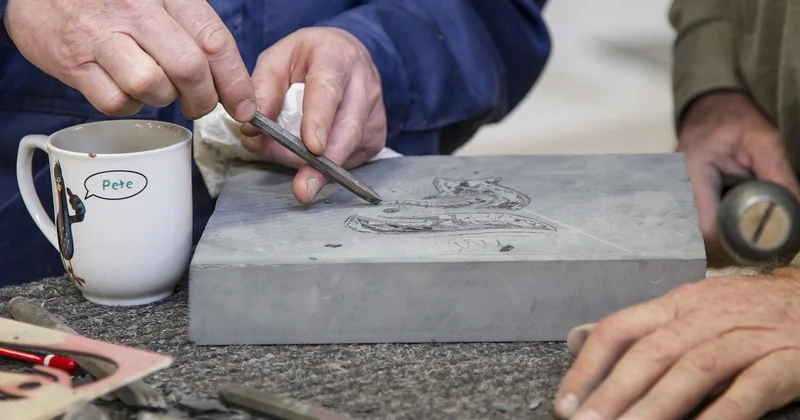
The demand side is healthier than you think
Every cathedral, every listed church, every historic civic building has stone that needs replacing. That work doesn't stop. Heritage restoration is steady, publicly and privately funded, and it needs skills that don't scale with a machine. New-build work in natural stone—cladding, features, high-end residential—adds another layer of demand. The need is real and it isn't going away.
What's fragile is the supply. The number of people who can do the specialist conservation work is small enough that a handful of retirements in one region can wipe out the local capacity entirely. That's not a dying trade in the sense of a trade nobody wants. It's a trade balanced on a knife-edge of numbers.
What actually threatens it
The threat isn't a lack of interest from young people. When I've talked to people in their early twenties who are considering the trade, the enthusiasm is genuine. The threat is economic: an apprentice wage is hard to live on, the work is physical, and the career path isn't obvious from the outside. Add a training system that's expensive for employers to run and you get the situation we have—demand that outruns the pipeline feeding it.
Why do most apprentices quit?
"Most" is doing heavy lifting in that question, and I'd push back on the framing slightly—plenty finish. But the dropout rate is real and high enough to hurt, and the reasons are rarely mysterious. Ask anyone who has run a training programme and they'll list the same handful.

Money first, always money
Apprentice wages in construction are low, and heritage work doesn't come with a premium to compensate. When you're young and renting, a low wage plus a long commute is a decision, not a preference. Plenty of capable people leave for work that pays more and asks less of their body.
The gap between the dream and the day
The image of stone carving—chisel, dust, a beautiful piece emerging—is seductive. The reality involves cold sites, heavy lifting, and long stretches of repetitive work. When an apprentice discovers the job is 80% preparation, some of them lose heart. The ones who stay tend to be the ones who were told the truth up front.
What retention actually looks like
Programmes that keep their apprentices do a few things differently, and none of them are exotic:
- Pay enough that the apprentice isn't deciding between the trade and eating.
- Show the career path explicitly—where does this lead in five years, and what does that look like?
- Give real responsibility early, even small. An apprentice who feels like a spare pair of hands leaves.
- Pair them with someone who actually wants to teach, not just someone senior.
The last one is the hardest to arrange and the most important. A brilliant mason who resents the time it takes to explain things will lose the apprentice faster than any pay packet.
What are the three types of apprenticeship?
If you're trying to make sense of how these programmes are funded and structured, the models fall into three rough categories. They differ in how progress gets measured, which matters enormously for a craft like masonry where the outcome is a physical object, not a test score.
| Model | How progress is judged | Best fit for traditional masonry |
|---|---|---|
| Time-served | A fixed number of years under a master, with completion tied to time and assessment | Strong—matches the slow learning curve of hand skills |
| Competency-based | Signed off when specific skills are demonstrated, regardless of time taken | Mixed—weak at capturing judgment and feel |
| Hybrid (levy-funded) | Day release to a college plus workplace assessment, funded through employer contributions | Good, if the college provision is genuinely craft-focused |
Why the time-served model still wins
In my view, the old time-served approach is the best fit for traditional masonry, and I'll defend that position. The reason isn't nostalgia. It's that hand skills develop on a curve that no competency checklist can measure—you get better at reading stone at month eighteen in a way you simply weren't at month six, and no signed-off box captures that. Competency-based models tend to reward ticking boxes over genuine mastery, which is the opposite of what a conservation craft needs.
The hybrid route is the pragmatic compromise
The levy-funded split model is where most of the money now sits, and it's a reasonable compromise: college gives structure and a qualification, the workshop gives the real learning. The risk is that the college side becomes the tail wagging the dog—the qualification gets prioritized over the craft. When it works, it works well. When it doesn't, you get apprentices who can pass an assessment but can't hang a moulding.
One thing worth knowing: the cost per apprentice is not trivial for a small workshop. Materials, supervision time, and the fact that an apprentice's output early on is well below a journeyman's mean the employer carries real risk. That's why the funded routes exist at all, and why small carving firms often can't participate without them.
What a real training day looks like
Here's a scene I remember, because it captured the whole model in an hour. A workshop with two apprentices and one mason who had been at it for over thirty years. The apprentices were cutting sections of a moulding, and the mason was going around with a straight edge, saying almost nothing. Just "again," occasionally, or a gesture with the hand to show the angle.
No lecture. No slides. Just correction, repeated until the hand did the right thing without the brain having to think about it. That's the apprenticeship model in one image, and it's why it survives despite everything stacked against it. You cannot replicate it with a video course.
What struck me was how much the mason deferred to the apprentices' own judgment once they'd earned it. By the second year, they were being asked, not told. That shift from instruction to consultation is the real milestone in a masonry apprenticeship, and it's invisible on any certificate.
The uncomfortable truth about the pipeline
The heritage sector loves an anniversary and a grant announcement. What it struggles with is the unglamorous business of paying a twenty-year-old enough to stay for four years. Every funded apprenticeship place is worth far more to the survival of these crafts than any heritage open day, because one produces a mason and the other produces a visitor.
If you're reading this and considering the trade—or you know someone who should be—the honest pitch is this. The work is hard, the pay early on is poor, and you will spend more time than you'd like sweeping up. But the skills you pick up are ones that machines can't replace, that buildings genuinely need, and that very few people can do. There aren't many jobs left where that's true.
The apprentices who finish are the ones who understood, from the start, that the craft is worth the grind. The question for the rest of us is whether we keep funding the places that let them find out.