You can spot a bad stone repair from thirty metres away. The mortar is too hard, too grey, too proud of the joint—and the stones around it are already spalling. Nobody notices the good repairs. That asymmetry is the whole job, and it's why restorers who come to stonework from a modern building background tend to struggle at first: everything you learned about speed, strength and uniformity works against you.
Traditional stonemasonry skills aren't a nostalgia project. They're a set of techniques developed to keep a wall standing for four hundred years without cracking the material it's made of. Get them wrong and you accelerate decay. Get them right and the intervention disappears into the building.
Key Takeaways
- Lime mortars, not cement, are the backbone of historic stonework—cement traps moisture and damages soft stone.
- Reading a stone (porosity, bedding plane, salt content) matters more than cutting it fast.
- Hand tools and judgment still outperform power tools on conservation work.
- Indent repairs and mortar matching are separate disciplines; both take years to master.
- The work is physically hard, but the mental load—diagnosis, sequencing, restraint—is what exhausts most people.
The traditional stonemasonry skills that actually matter on site
Ask five restorers what a stonemason does and you'll get five different answers. Ask them what a stonemason must be able to do, and the answers converge fast. Below is the working order I'd teach someone coming into conservation work—not the order a college course teaches it, which is usually the reverse.
Reading the stone before you touch it
Every stone has a bedding plane—the direction it was laid down in the quarry. Cut across it and the stone will delaminate within a decade or two, regardless of how neatly you dressed it. This is the first thing to learn and the easiest to skip when you're under time pressure.
Beyond bedding, you're assessing porosity, hardness, mineral composition and vulnerability to salts. A soft limestone that's been absorbing groundwater for a century is a completely different problem from a dense sandstone with a surface crust. The diagnostic step—sometimes just tapping and listening, sometimes a simple absorption test—determines everything downstream: which replacement stone, which mortar mix, how deep to cut back.
My rule of thumb: if I can't explain to a client why a specific stone was chosen, I'm not ready to order it. That sounds obvious. In practice, plenty of repairs get specified from a photograph.
Lime mortar literacy
This is where most modern-trained builders get into trouble. Cement mortar is strong, fast and cheap. It's also, on a soft historic stone, a slow-acting demolition tool. It's harder and less permeable than the stone around it, so moisture gets trapped behind the joint and finds its way out through the masonry face instead. The stone erodes; the mortar doesn't.
Lime works the other way round. It's softer and more vapour-permeable than the stone, so any movement and moisture resolve in the joint rather than in the building fabric. Knowing which lime—hydraulic, non-hydraulic, feebly hydraulic—and at what mix ratio, and how long to protect it while it cures, is a skill you build over years. I still keep a notebook of mixes that failed on specific stone types. There are more entries than I'd like.
- Non-hydraulic lime: slow set, high permeability, suitable for soft interior and sheltered stonework
- Feebly hydraulic: a middle ground for exterior walls exposed to weather
- NHL 3.5 and above: reserve for genuinely hard stones or very exposed conditions
- Aggregate grading: matching the original joint's texture and colour, not just its strength
Hand-tool carving and dressing
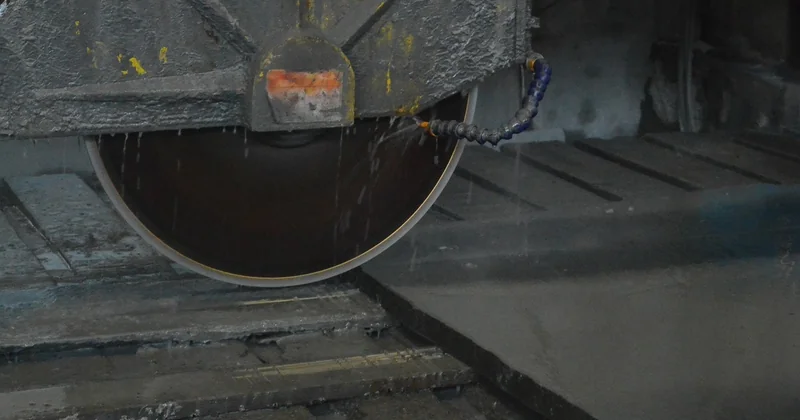
You can dress a stone with a disc cutter in a fraction of the time. On restoration work, you'll often be told not to. Chisels, mallets, a bolster, a pitcher and a good set of lettering tools give you control that a spinning blade cannot: you can follow a moulding profile that was cut by hand in 1780, and you can stop exactly where the historic surface begins.
That last point is the one nobody tells beginners. Most restoration damage isn't caused by bad cutting. It's caused by cutting too much, or by "cleaning up" an edge that should have been left alone.
What are the essential skills of a mason?
The core set is narrower than people expect. A mason needs to be able to select and assess material, dress and shape stone accurately to a line and template, set out and build to a level and plumb, mix and place mortar correctly for the material, and understand how a wall carries load. Add one soft skill that isn't soft at all: the judgment to know when to stop.
Conservation work adds layers on top—recording, matching, minimum intervention—but it never replaces the fundamentals. If you can't build a straight wall in the first place, you can't restore one.
What is the hourly rate for a stonemason?
Rates vary enormously by region, specialism and whether the work is private or contract. As a general shape rather than a quote: a general mason sits in the lower-middle band for skilled trades, while a conservation-accredited stonemason with carving or lettering ability commands a clear premium, and a specialist working on listed ecclesiastical or heritage fabric sits at the top.

My advice is to quote the job, not the hour. Restoration work has too many variables—hidden decay, access, mortar curing time—for an hourly figure to be meaningful. Any restorer who asks you for a straight hourly number is probably planning to compare you with someone doing a very different job.
What skills do you need to work as a masonry worker?
Physical stamina, spatial reasoning and patience come first. Then accuracy—the ability to hold a line over a long day, because fatigue shows up in the joints before it shows up anywhere else. And increasingly, documentation: photographs, notes, records of what you removed and why, which on heritage projects is part of the deliverable rather than an afterthought.

What most people underestimate is material literacy. Being able to look at a stone and describe what it will do in twenty years is a skill that takes a decade to build and no certificate to prove.
Is being a stone mason a hard job?
Yes, and not only in the way you'd expect. The lifting, the kneeling, the cold hands in February—that's real, and it wears people down. But the harder part is the concentration. One careless strike on a carved capital and you've destroyed something irreplaceable, and no amount of skill fixes it afterwards.
That combination is why so many good masons burn out in their thirties and why the ones who stay tend to be unusually deliberate people. The trade rewards restraint more than strength.
Matching and indent repairs: the skill that separates restorers from builders
When a stone is too far gone to conserve, you replace it—but you replace it in context. An indent repair means cutting back only the decayed portion and letting in a new piece, matched to the host in colour, texture, tooling and finish. The joint should be as narrow as the material allows and the mortar as recessive as possible.
| Approach | Typical use | Main risk |
|---|---|---|
| Full stone replacement | Severely decayed or structurally compromised units | Loss of historic fabric; visible mismatch |
| Indent repair | Localised decay on otherwise sound stones | Poor joint alignment; moisture ingress if mortar is wrong |
| Mortar repair / consolidation | Surface loss, small voids, friable faces | Over-filling; creating a hard skin over soft stone |
| Do nothing, monitor | Stable decay that isn't progressing | Requires honest diagnosis and a return visit |
That last row is the one nobody puts in a tender document. Sometimes the correct intervention is a photograph, a date and a note to come back in three years. Learning to write that report—and to defend it—is a skill in itself.
If you're starting out, learn these four things first
- Identify stone type and bedding direction on every job, before specification.
- Mix and cure lime mortar properly—including how to protect it from frost and sun.
- Cut to a template by hand, accurately enough that someone else could match your work.
- Record everything you remove, with dimensions and photographs.
Everything else—carving, lettering, moulding profiles—sits on top of those four. Skip them and you'll produce work that looks convincing for five years and starts failing at ten.
The uncomfortable truth about restoration is that the best work is invisible. Nobody will thank you for a joint that disappeared into the wall, or a replacement stone that nobody can pick out from the originals. The reward is a building that stands another century without anyone needing to explain what went wrong.